


25th ISTANBUL International Conference on Advances in Electronics, Control and Computing Systems (AEC2S-26) April 29-May 1, 2026 Istanbul (Türkiye)
AEC2S-26
- URL: https://eaceee.erpub.org/conference/193
- Event Date: 2026-04-29 ~ 2026-05-01
- Submission Date: 2026-04-02
- Organizer: EACEEE
- Location: Istanbul, Turkey
Automation & Control Theory Microelectronics & Electronic Packaging
Call for papers/Topics
Topics of Interest for Submission include, but are Not Limited to:
1. Electronics: Devices, Circuits, and Systems
This area focuses on the physical hardware, from nanometer-scale transistors to complex integrated systems.
Advanced Semiconductor Materials
Wide-bandgap semiconductors (GaN, SiC) for power efficiency.
2D materials (Graphene, Transition Metal Dichalcogenides).
Organic and flexible electronics for "electronic skin" and wearables.
Integrated Circuits (IC) & VLSI Design
Low-power Analog and Mixed-Signal circuit design.
Radio Frequency (RF) and Microwave ICs for 6G.
Advanced IC Packaging (3D-IC, System-in-Package).
Neuromorphic & Bio-inspired Hardware
Memristor-based synaptic circuits.
Neural Processing Units (NPUs) for on-device AI.
Hardware Security
Physically Unclonable Functions (PUFs).
Side-channel attack resilience and cryptographic hardware.
2. Control Systems and Automation
Control theory provides the "brain" for machines to operate autonomously or follow precise instructions.
Advanced Control Theory
Model Predictive Control (MPC): Computationally efficient algorithms for real-time systems.
Adaptive and Robust Control: Systems that handle high uncertainty or changing environments.
Fractional-Order Control: Advanced mathematical modeling for complex dynamics.
Autonomous Systems and Robotics
Unmanned Vehicles: Self-driving cars, UAVs (Drones), and underwater robotics.
Human-Robot Interaction (HRI): Collaborative robots (Cobots) and haptic feedback.
Swarm Robotics: Decentralized control of multi-robot systems.
Industrial Automation (Industry 4.0/5.0)
Digital Twins: Real-time virtual replicas of physical manufacturing lines.
Smart Factories: Integration of IIoT (Industrial IoT) with automated logistics.
Process Control: Automation in chemical, oil/gas, and energy sectors.
3. Computing Systems and Software Engineering
This section covers the computational frameworks and architectures that process data and run algorithms.
Artificial Intelligence & Machine Learning
Generative AI & LLMs: Efficiency optimization for deployment on edge devices.
Explainable AI (XAI): Making autonomous decisions transparent for safety-critical systems.
Edge AI: Moving computation from the cloud to the local device for zero latency.
Next-Generation Computing Paradigms
Quantum Computing: Quantum algorithms, error correction, and quantum-resistant cryptography.
Cloud & Fog Computing: Hybrid architectures for big data processing.
High-Performance Computing (HPC): Parallel processing and supercomputing architectures.
Cybersecurity and Data Privacy
Blockchain Technology: Decentralized ledgers for secure IoT and supply chains.
Zero Trust Architecture: Dynamic security models for interconnected systems.
Bioinformatics: Computing systems for genomic sequencing and personalized medicine.
4. Communication and Signal Processing
The bridge between electronics and computing, focusing on how information is transmitted and interpreted.
5G-Advanced and 6G Foundations
Terahertz (THz) communication and ultra-low latency networks.
Satellite-to-device communication and LEO (Low Earth Orbit) constellations.
Signal Processing Applications
Image & Video Processing: Real-time semantic segmentation for computer vision.
Biomedical Signal Processing: Analysis of EEG/ECG for health monitoring.
Multi-sensor Data Fusion: Combining radar, lidar, and camera data for navigation.
5. Energy and Power Systems
Modern electronics and control are increasingly focused on the "Green Transition."
Smart Grids and Microgrids
Distributed energy resource management using AI.
Power electronic converters for renewable energy (Solar/Wind) integration.
Electric Mobility (e-Mobility)
Battery Management Systems (BMS) and fast-charging infrastructure.
Motor drive control for high-efficiency electric vehicles (EVs).
Event Promotion

|
|
The 13th International Conference on Quantum Dots (QD 2026) |
| 2026-05-17 ~ 2026-05-22 |
|
|
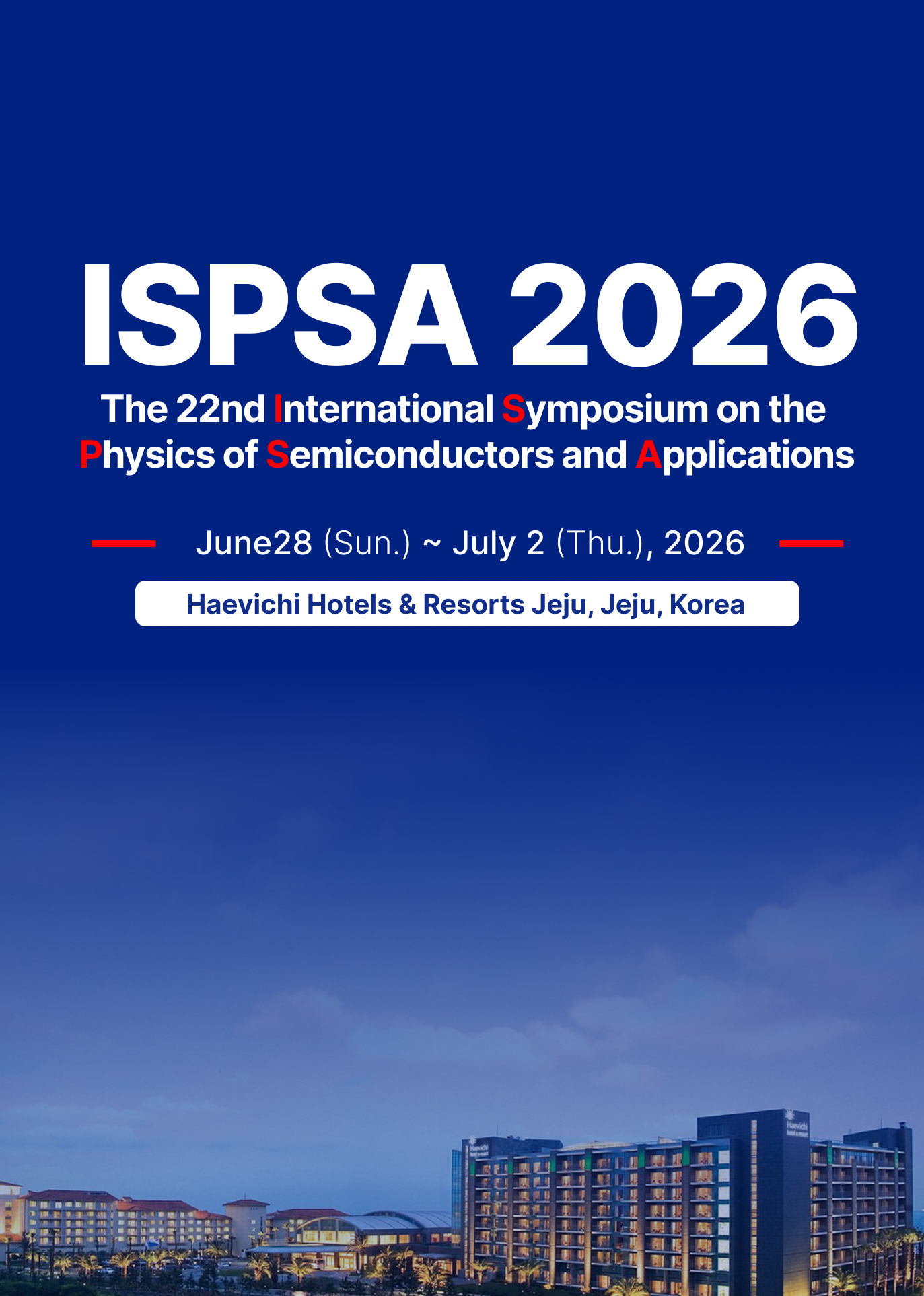
The 22nd International Symposium on the Physics of Semiconductors and Applications (ISPSA 2026) |
| 2026-06-28 ~ 2026-07-02 |

|
|
The 15th Asia-Pacific Conference on Transportation and the Environment (APTE 2026) |
| 2026-07-08 ~ 2026-07-10 |

|
|
ACEM26 / Structures26 (ACEM26) |
| 2026-08-24 ~ 2026-08-25 |
Journal Promotion

|
| Acta Koreana (Acta Koreana) |

|
| Acta Via Serica (AVS) |

|
| Advances in Concrete Construction (Advances in Concrete Construction ) |

|
| Advances in Nano Research (Advances in Nano Research) |

|
| Computers and Concrete (Computers and Concrete) |

|
| Earthquakes and Structures, An International Journal (Earthquakes and Structures) |

|
| Geomechanics and Engineering (Geomechanics and Engineering) |

|
| Journal of Information Processing Systems (JIPS) |

|
| Journal of Internet Computing and Services (KSII - JICS) |

|
| Membrane and Water Treatment (MWT) |

|
| Smart Structures and Systems (Smart Structures and Systems) |

|
| Steel and Composite Structures, An International Journal (Steel and Composite Structures) |

|
| Structural Engineering and Mechanics, An International Journal (Structural Engineering and Mechanics) |

|
| Wind and Structures, An International Journal (Wind and Structures) |




MANUSCRIPTLINK © 2015 -
