


The 2nd International Conference on Federated Learning and Intelligent Computing Systems (FLICS2026)
FLICS 2026
- URL: https://www.flics-conference.org/
- Event Date: 2026-06-09 ~ 2026-06-12
- Submission Date: 2026-02-20
- Organizer: IEEE
- Location: Valencia, Spain
Computational Linguistics Computer Graphics Computer Security & Cryptography Computer Vision & Pattern Recognition Computing Systems Data Mining & Analysis Databases & Information Systems Artificial Intelligence Automation & Control Theory Bioinformatics & Computational Biology
CFP: The 2026 International Conference on Federated Learning and Intelligent Computing Systems (FLICS 2026)
https://flics-conference.org/index.php
Valencia, Spain, June 9–12, 2026
Technically Co-sponsored by IEEE Spain Section.
Important: Selected papers will be invited to the Expert Systems or Cluster Computing Journals.
Conference Scope
The Federated Learning and Intelligent Computing Systems (FLICS) Conference brings together researchers, practitioners, and industry leaders to explore the convergence of federated learning with intelligent computing systems, edge AI, and autonomous workflows. As we advance toward 6G networks, pervasive edge intelligence, and decentralized cyber-physical systems, the need for collaborative, privacy-preserving learning approaches has never been more critical.
FLICS 2026 features two main tracks that address complementary aspects of modern intelligent computing:
Main Track 1 – Federated Learning Systems & Applications
This track focuses on the fundamental challenges and innovations in federated learning, including scalable architectures, privacy and security mechanisms, communication efficiency, personalization, edge computing integration, and real-world deployments. This track addresses the core technical foundations of federated learning systems and their applications across diverse domains such as healthcare, finance, industrial IoT, and smart cities.
Main Track 2 – Intelligent Computing Systems
This track explores cutting-edge technologies and applications in intelligent computing systems, including large language models, generative AI, deep learning architectures, agentic AI workflows, digital twins, and smart city applications. This track bridges the gap between federated learning and emerging AI paradigms, addressing the systems, infrastructure, and interdisciplinary applications that drive the next generation of intelligent computing.
FLICS 2026 provides a unique platform for interdisciplinary collaboration, bridging theoretical foundations and practical implementations. The Conference welcomes contributions from both researchers and practitioners across both tracks, fostering dialogue between specialists in federated learning and experts in intelligent computing systems.
Important Dates
- Paper submission: February 20, 2026
- Notification of acceptance: April 15, 2026
- Camera-ready deadline: May 5, 2026
Main Track 1 – Federated Learning Systems & Applications
Federated Learning Systems & Edge Intelligence
- Scalable FL architectures and large-scale deployments
- Cross-silo and cross-device federated learning
- Hardware-aware and resource-efficient FL
- Communication-efficient FL (quantization, sparsification, compression)
- FL under client mobility and heterogeneity
- Benchmarks and evaluation frameworks for FL
- FL deployment in UAVs, mobile edge clouds, autonomous systems
Privacy, Security, and Trust in FL
- Privacy-enhancing technologies
- Secure aggregation protocols and cryptographic methods
- Explainable and trustworthy FL
- Resilient FL against adversarial attacks
- Privacy–utility trade-offs
- Auditable FL frameworks
Communication & Resource Efficiency for FL
- Model and gradient compression
- Sparse and adaptive communication
- Energy-efficient FL
- Hierarchical and clustered FL
- Multi-objective optimization
Personalization & Fairness in FL
- Personalized FL
- Fairness-aware FL
- Meta-learning for FL
- Bias mitigation
- Clustered and multi-task FL
Edge Computing, IoT, and Mobile/Wireless FL
- Edge–cloud FL architectures
- IoT orchestration
- FL in 5G/6G and vehicular networks
- Real-time FL systems
Advanced FL Paradigms
- Federated deep learning and GNNs
- Federated reinforcement learning
- Federated generative models
- Neuro-symbolic FL
Applications & Real-World Deployments
- Healthcare and medical AI
- Financial services and risk modeling
- Industrial IoT and predictive maintenance
- Smart cities and infrastructure
- NLP and computer vision via FL
Emerging & Interdisciplinary FL Directions
- Continual and lifelong learning
- Quantum FL
- Neuromorphic FL
- Blockchain for FL
- Sustainable and green FL
Main Track 2 – Intelligent Computing Systems & Emerging AI Paradigms
Large Language Models, Generative AI & NLP
- LLM architectures and training
- Prompting, fine-tuning, alignment
- Multi-modal generative AI
- NLP for intelligent assistants
- Evaluation and robustness
Deep Learning & Advanced Intelligent Systems
- Novel deep learning architectures
- Transformers, GNNs, hybrid models
- Continual learning and transfer learning
- Deep reinforcement learning
Agentic AI & Autonomous Workflows
- Agentic AI systems and workflow automation
- Multi-agent systems and collaborative intelligence
- User–agent interaction and personalization
Digital Twins, Cyber-Physical & Intelligent Systems
- Digital twins for industry and cities
- Real-time monitoring and simulation
- Edge AI for CPS
Intelligent Systems for Smart Cities & Urban Computing
- Urban mobility optimization
- Smart energy systems
- Urban sensing and IoT
- AI for emergency response
- Urban digital twins
Systems, Infrastructure & Platforms
- Distributed systems for AI workloads
- Hardware acceleration
- Performance and energy optimization
Applications & Interdisciplinary Case Studies
- Healthcare and life sciences
- FinTech and risk modeling
- Industry 4.0 and robotics
- Education and digital services
- Sustainability and environmental monitoring
Submission Types
- Research Papers: up to 8 pages
- Short Papers: up to 6 pages
- Posters: up to 2 pages
- Artefacts & Demonstrations: up to 6 pages
Contact Information
For submission questions, contact:
Sadi Alawadi – sadi.alawadi@bth.se
Event Promotion

|
|
The 13th International Conference on Quantum Dots (QD 2026) |
| 2026-05-17 ~ 2026-05-22 |
|
|
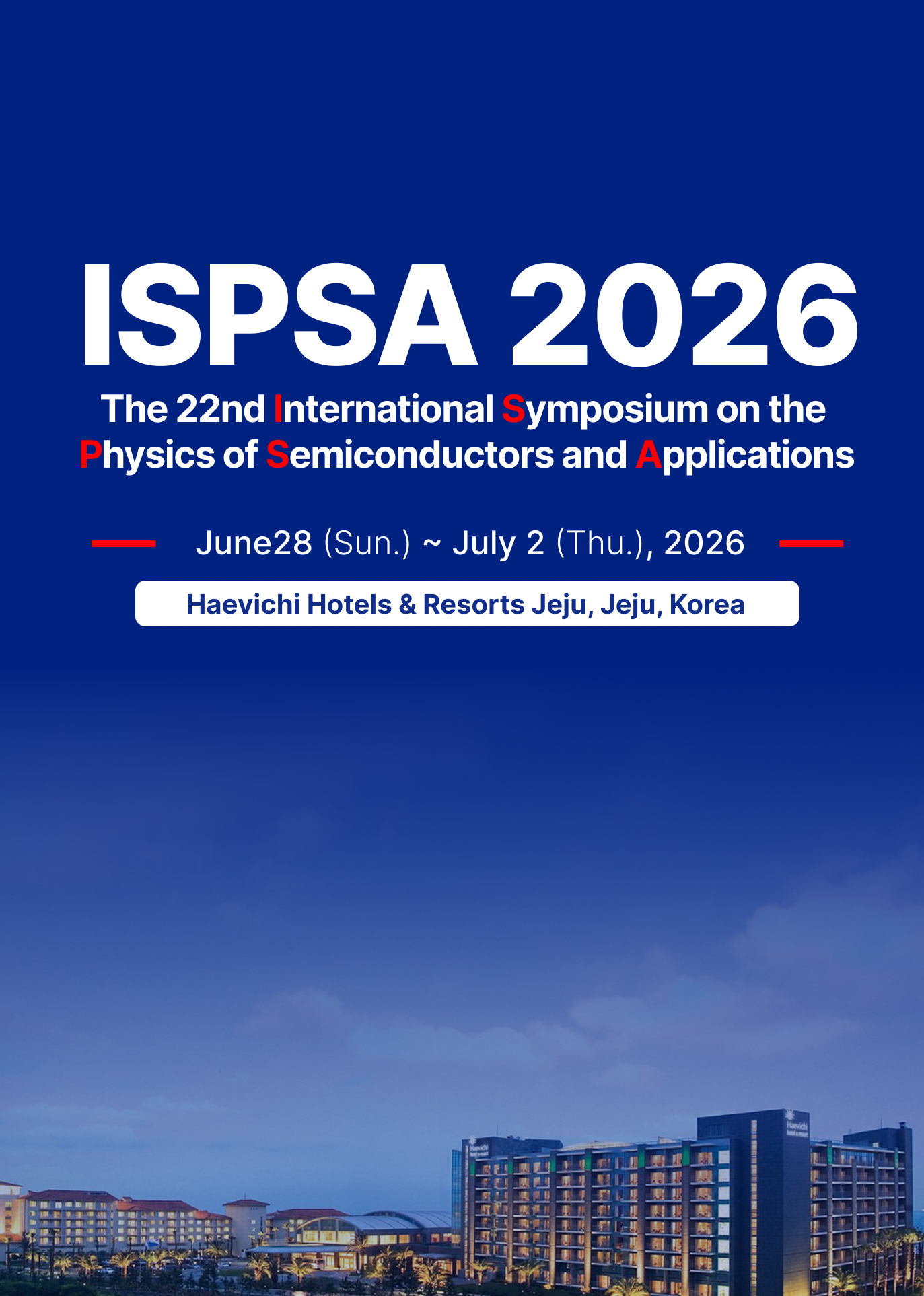
The 22nd International Symposium on the Physics of Semiconductors and Applications (ISPSA 2026) |
| 2026-06-28 ~ 2026-07-02 |

|
|
The 15th Asia-Pacific Conference on Transportation and the Environment (APTE 2026) |
| 2026-07-08 ~ 2026-07-10 |







MANUSCRIPTLINK © 2015 -
