


LISBON 9th International Conference on Advances in Computing, Engineering & Cybersecurity (LACEC-27) Aug. 16-18, 2027 Lisbon (Portugal)
LACEC-27
- URL: https://fenp.org/conference/384
- Event Date: 2027-08-16 ~ 2027-08-18
- Submission Date: 2027-08-02
- Organizer: FENP
Computational Linguistics Computer Graphics Computer Hardware Design Computer Networks & Wireless Communication Computer Security & Cryptography Computer Vision & Pattern Recognition Computing Systems Engineering & Computer Science (General) Bioinformatics & Computational Biology
Call for papers/Topics
Topics of interest for submission include any topics related to:
Artificial Intelligence, Machine Learning, and Automated Systems
Generative AI Models and Architecture: Development of foundation models, large language models, and diffusion systems driving automated tasks.
Adversarial Machine Learning: Engineering resilience against data poisoning, model inversion, and prompt injection attacks.
AI-Powered Threat Detection: Applying continuous anomaly detection and behavioral predictive models to isolate network attacks.
Automated Software Engineering: AI-assisted code generation, static security scanning, and automated bug refactoring during production.
Quantum Information Processing and Hardware
Quantum Computing Architectures: Hardware implementations using superconducting qubits, trapped ions, and photonic circuits.
Post-Quantum Cryptography: Designing lattice-based and code-based cryptographic primitives immune to quantum decryption.
Quantum Key Distribution: Quantum physics-based communication protocols ensuring untamperable key exchange over optical channels.
Quantum Simulation for Engineering: Utilizing quantum systems to model material physics, chemical reactions, and thermal mechanics.
Cyber-Physical Systems, IoT, and Critical Infrastructure
Industrial Control System Security: Protecting SCADA and operational technology (OT) platforms from targeted physical and digital sabotage.
Internet of Things Architecture: Designing low-power processing hardware and micro-kernels for distributed sensors.
Autonomous Vehicle Engineering: Software safety standards, sensor fusion, and anti-hijacking controls for autonomous transit.
Digital Twins for Systems Engineering: Virtual mirror modeling of physical infrastructure to simulate wear, load, and cyber-attack scenarios.
Distributed Systems, Cloud, and Edge Computing
Confidential Computing: Utilizing hardware-enforced Trusted Execution Environments (TEEs) to process encrypted data safely.
Edge Intelligence and Fog Computing: Distributing compute capacity closer to data sources to lower latency and preserve network bandwidth.
Zero Trust Architecture: Continuous identity verification, strict access controls, and micro-segmentation across distributed multi-cloud networks.
Decentralized Infrastructure and Ledger Systems: Using consensus mechanisms and smart contract security to secure supply chains and immutable logging.
Software Engineering, DevSecOps, and Supply Chain
DevSecOps Automation: Embedding static and dynamic continuous integration pipeline security testing directly into development workflows.
Software Supply Chain Security: Managing Software Bill of Materials (SBOMs), verifying open-source dependencies, and preventing repository attacks.
Microservices and Container Security: Securing orchestration platforms, API gateways, and container runtime environments.
Formal Verification and Code Correctness: Mathematical proof techniques applied to software systems to guarantee safety and vulnerability absence.
Privacy-Preserving and Applied Cryptography
Homomorphic Encryption: Cryptographic schemes allowing mathematical computations directly on encrypted data without prior decryption.
Federated Learning and Differential Privacy: Training machine learning models across decentralized nodes while mathematically protecting individual node privacy.
Zero-Knowledge Proofs: Cryptographic methods proving statement validity without revealing underlying sensitive information.
Hardware Security and Roots of Trust: On-chip cryptographic coprocessors, physically unclonable functions (PUFs), and side-channel attack countermeasures.

Journal Promotion

|
| Acta Koreana (Acta Koreana) |

|
| Acta Via Serica (AVS) |

|
| Advances in Concrete Construction (Advances in Concrete Construction ) |

|
| Advances in Nano Research (Advances in Nano Research) |

|
| Computers and Concrete (Computers and Concrete) |

|
| Coupled Systems Mechanics (Coupled Systems Mechanics) |

|
| Earthquakes and Structures, An International Journal (Earthquakes and Structures) |

|
| Geomechanics and Engineering (Geomechanics and Engineering) |
|
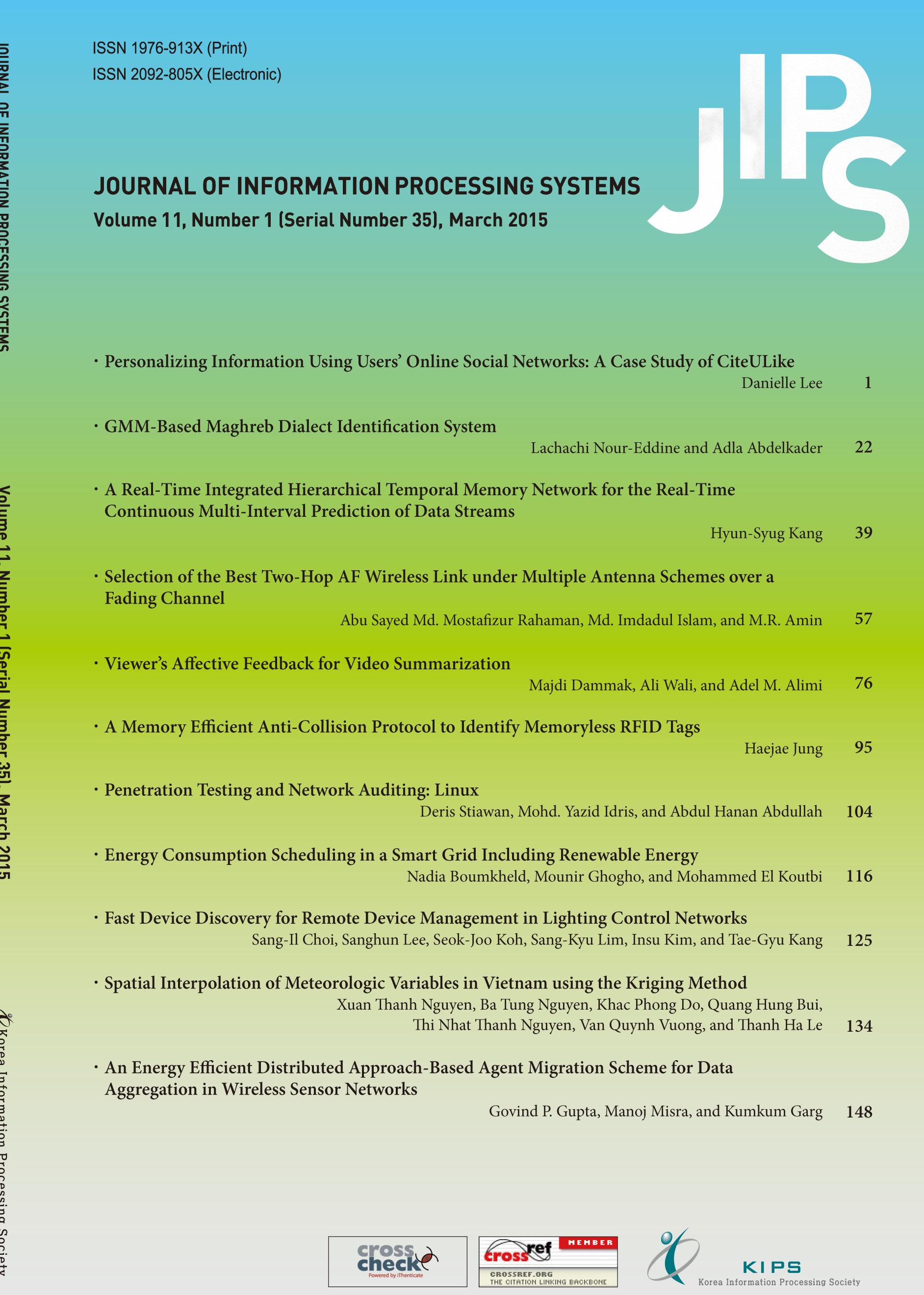
| Journal of Information Processing Systems (JIPS) |

|
| Journal of Internet Computing and Services (KSII - JICS) |

|
| Membrane and Water Treatment (MWT) |

|
| Smart Structures and Systems (Smart Structures and Systems) |

|
| Steel and Composite Structures, An International Journal (Steel and Composite Structures) |

|
| Structural Engineering and Mechanics, An International Journal (Structural Engineering and Mechanics) |

|
| Wind and Structures, An International Journal (Wind and Structures) |




MANUSCRIPTLINK © 2015 -
